How I Broke Writer’s Block Part 1: The Story Behind the Book

Breaking Writer’s Block Part 1: Behind the Scenes

I did a thing–a big thing. I broke a two-year stint of writer’s block. As a romantic comedy novelist, I had hit a brick wall with my emotional connection to letting the words flow. Sure, I’d managed to prepare to write during that gargantuan span of time, but it was all busy work.

With multiple outlines for novels done and a plan in place to wrap up one series then start two more, I was all set. All my characters were holding their breath waiting … and waiting. I even had a partial manuscript—we’re talking 20k words—suspended in limbo like fruit cocktail in a Jell-O mold. What I just needed was my life to permit me to write unencumbered. I had endless notes, lines, scenes, even oodles of research done, but the words were trapped inside me bound by chaos, also known as, severe anxiety.
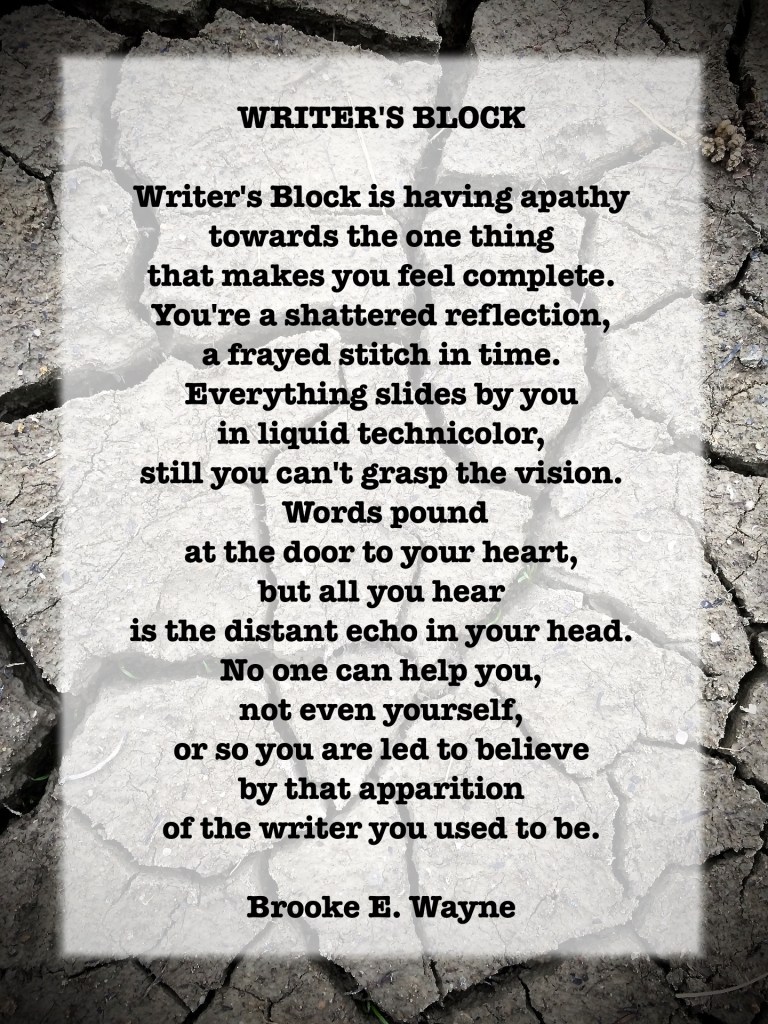
Writing has always been a balm to my soul, but during this awful stretch of hell on earth, it was like having someone offer me cheesecake when I have the stomach flu. I didn’t want to write even though it would be wonderful. I couldn’t let my lighthearted romantic stories become associated with the daily stress I was wrestling with due to circumstances in my life that were (and still are) beyond my control.

I tried all the typical writerly techniques and even some atypical ones to get back into the groove of writing despite my anxiety (which I’m still battling), and they helped me just enough for me to heed my friend’s advice on getting back to the basics with what I know. So, determined to tap into my teaching skills, I pulled up my big-girl pants, parked my bootie in a hotel room (long, hot story) and over the summer, I penned a How-To book.

Yes, I smashed my writer’s block with a How-To book. It’s worth repeating twice, because, even as I write this, I can’t believe it. I freaking can’t believe I’m sitting here typing this with yet another publication on Amazon! Is it ironic that I wrote a book about how to write in order to break my writer’s block? I’ll be writing a Part 2 blog on the techniques I used to bring myself to the threshold of writing this new book soon, I promise.

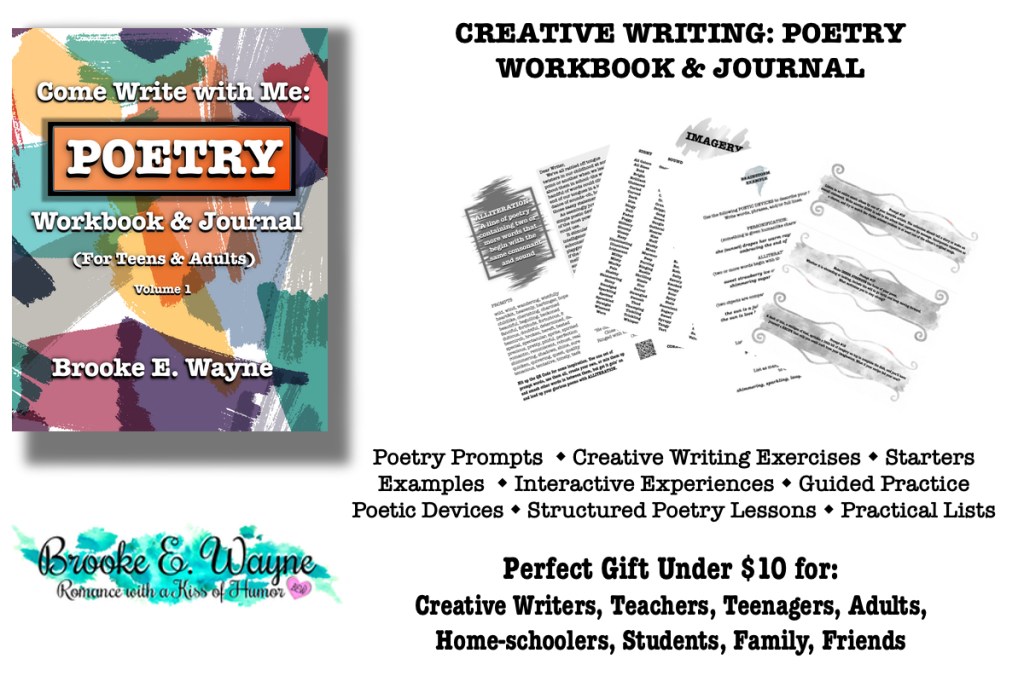
I’m a teacher by trade. I’ve got worksheets galore that I’ve created, as well as a full-blown smarty pants attitude that goes well with writing instructional materials. I crafted Come Write with Me: POETRY Workbook & Journal (For Teens & Adults) Vol 1 like I was sipping coffee and hanging with my invisible student. It was the best two months of anxiety-riddled fun I’d ever had with my imagination. As a result, the workbook is full of chatty ramblings, advice, quips, some of my gushy poetry, and I even loaded it with several QR codes that link to my blog with posts of additional content and exercises. Overall, this workbook & journal is sweet!

It took two months of writing everyday to accomplish this monumental feat in my life. I’m proud of the product. I’m proud of myself. I’ll be writing another blog about the techniques I used to bring me to the point that this workbook spilled out of me freely. It’ll be worth the read if you are or have ever been ‘stuck’ like me. Are you a writer? Does poetry matter to you? Would you like to learn how to write creatively starting with something simple like a poem? Are you a seasoned writer wishing to polish up on some poetic devices that you can tuck neatly into your work? I know the perfect book for you … come write with me.

SEE: HOW I BROKE WRITER’S BLOCK PART 2: TECHNIQUES
AVAILABLE ON AMAZON

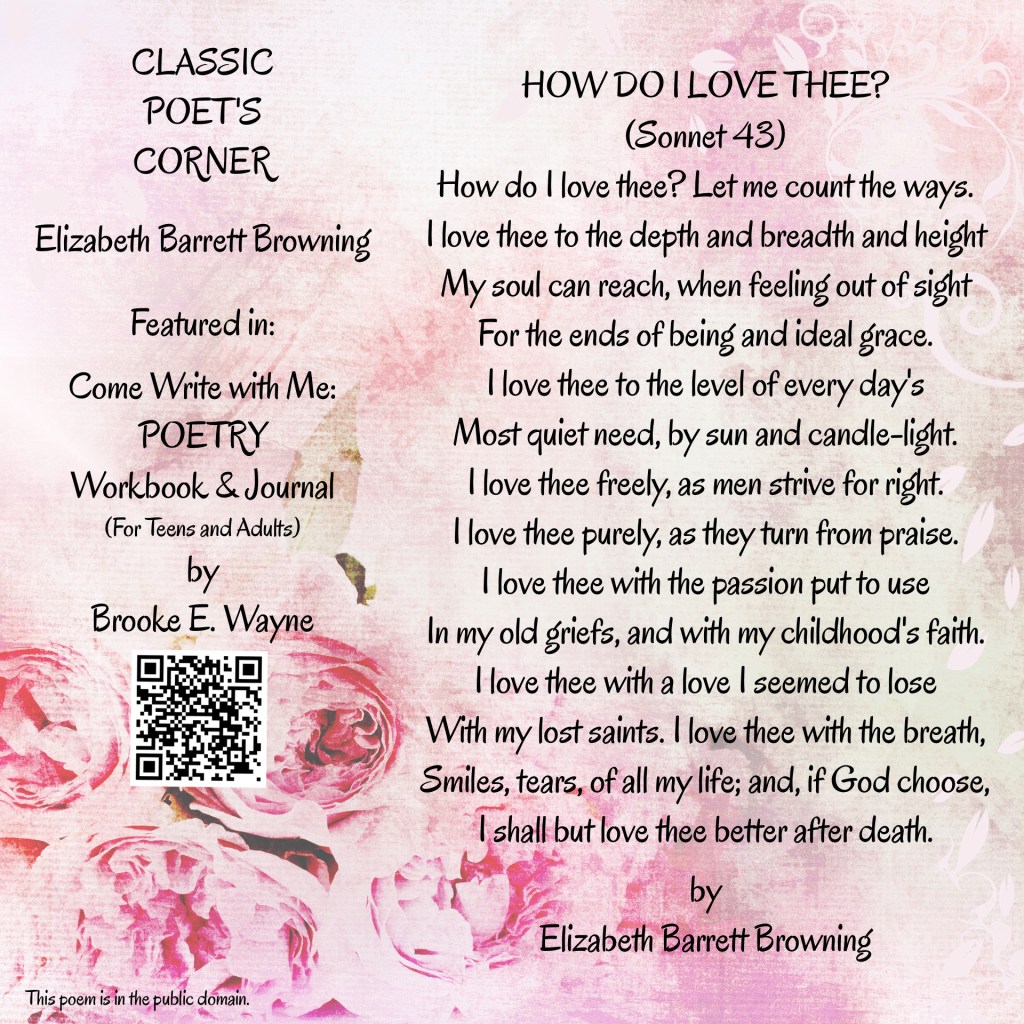
CLASSIC POET’S CORNER: Elizabeth Barrett Browning

A Lesson in HYPERBOLE

Whether you’ve stumbled upon this section of my website by accident, or if you zapped one of the QR codes in my latest publication, WELCOME!

We’ve all heard the opening line of Elizabeth Barrett Browning’s most beguiling love poem, Sonnet 43. We’ve quoted it, parodied it, seen it in textbooks and on coffee mugs, and have probably heard it at a dozen weddings or more. It sings of true love—a heart bursting with emotional truths—and maybe a tad bit of unhealthy obsession, too.

Browning’s playful extremes, aching with desperation, resonate with anyone who has ever fallen irrevocably in love with someone–a love so deep the idea of death do us part doesn’t even seem like it could bring those feelings closure.

As a writer, it would be a practical exercise to mimic this poem. Why? The poem’s overuse of hyperbolic statements makes it a wonderful lesson in going to the extreme. Writing a poem in general is like pouring a glass of wine into a thimble and doubting the sip will embody all the wine’s fruity notes…and yet, it does. One tiny drop of wine on the tongue can deliver its overall explosive flavor to your taste buds—that’s why wine tasting is just that—a sip. (If you’re a teen, disregard my implied metaphor and think, wow, that stick of gum still tastes like mint even after I’ve been chewing on it for an hour. I bet my breath will stay fresh forever!)

Poems hold everything a reader needs to know to fully understand the poet’s intentions in just a few verses or stanzas, like a sip of wine (or a stick of gum–just go with it).

            Emulating Sonnet 43 in your own original poem will give you an opportunity to mess around with hyperbole—a play on words easily overlooked as a poetic device because of their overuse in everyday life as common language. A hyperbole is an absurd exaggeration meant to prove a point. Your creative challenge will be to veer from the theme of love that Browning expounded upon, and dive into another emotion wrapped around a different context.

Here are some possible prompts to create your own hyperbolic poem:

Your passion for writing

Your anguish over a political topic

Your hope in a dream coming true someday

Your sorrow over the loss of something valuable

Your determination in reaching a goal

Your grief in losing someone you love

Your inner strength and focus on self-care

Your rage over a situation in which you were wronged

Your joy in accomplishing a project

Your respect for someone you admire

Your responsibility towards someone you care about

Your fears towards something you cannot control

Now, go forth, you imaginative artist, and write some hardcore, over-the-top poetry, and feel free to overuse the pesky exclamation point all you want!!! I can’t wait for you to share your poetry with me!

~ Brooke E. Wayne

AVAILABLE ON AMAZON
BUY ON AMAZON

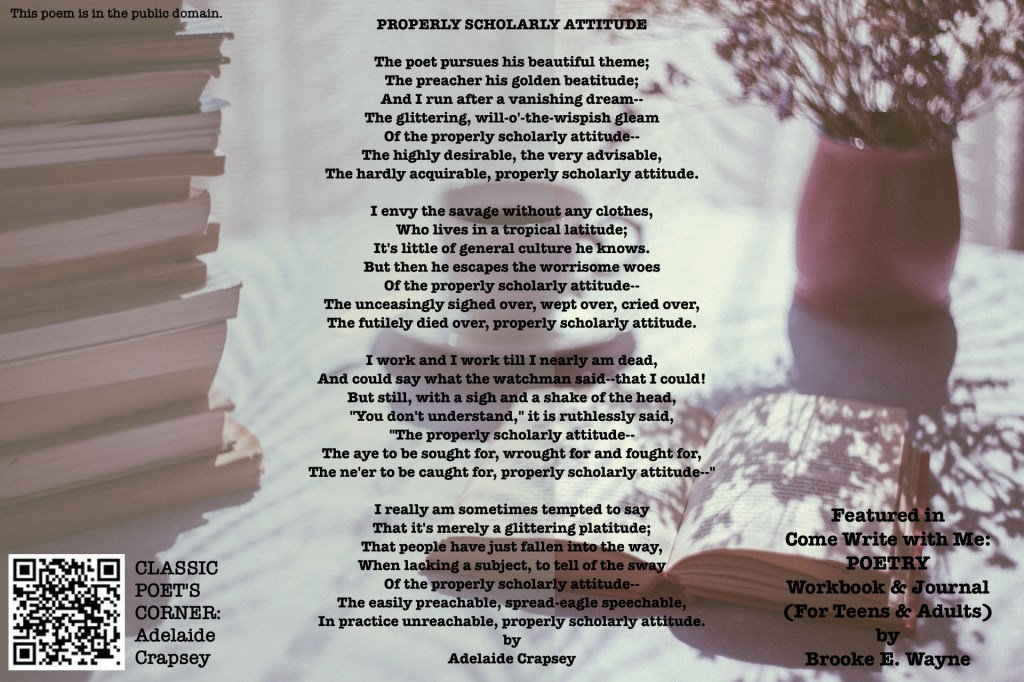
CLASSIC POET’S CORNER: Adelaide Crapsey

A Lesson in REPETITION

Whether you’ve stumbled upon this section of my website by accident, or if you zapped one of the QR codes in my latest publication, WELCOME!

Repetition, as a poetic device, can seem like a shortcut to making your poem longer, but it’s actually a multifaceted technique that makes your poetry shiny and reflective. You’ve heard of the poem about all the miles to go before that guy can sleep. You know the one where he’s trudging through the woods on a snowy evening. Ring any bells? No? Frost, anyone? Anyone? Celine Dion borrowed his line for a song; I even stumbled across a weightloss blog that lifted the phrase, too. The point is, repetition sticks in people’s heads, so they use it (even if it’s someone else’s line). People like it, connect to it, and feel all cozy and familiar because of it. That’s not a bad thing. You want your poem to be remembered, right? Throw a catchy line in it, then lather, rinse, and repeat every stanza or so.

Notice how Adelaide Crapsey uses the phrase, “properly scholarly attitude,” like an excuse, a weapon, a fault, a badge, and even an unattainable burden? As the inventor of the Cinquain poem, she knows her way around repetition in all sorts of manifestations. In this poem’s case, the meaning of the repeated phrase changes with every utterance due to its context.

As my “Dear Writer,” section of my poetry workbook and journal explains, REPETITION comes in different flavors. You can have the standard repeating of a word, phrase, verse, or more (think couplet/quatrain, etc.) You can also sprinkle a bunch of synonyms in your poem, and voilà, there’s a concept repeated. Patterns, rhythms—you name it—do it more than once, and check off this device as done.

The other thing you might want to know about repetition as an FYI thing is that it takes on specific (Greek and Latin rooted fancy-shmancy) names depending on where you plug your repetition into your work and how. (For example: Anaphora—a word or phrase that hangs out at the front of a line … Mesodiplosis—a word or phrase that hangs out in the middle of every line …) Shall I go on? Overwhelmed much? I’ll save the full-blown college course on all these types of repetition for another blog (or workbook) … Let’s keep it simple with what’s commonly referred to as a REFRAIN (which hangs out at the end of a stanza, like in Crapsey’s poem above) for this exercise.

Here are some one-liners you can use in your work, if you want, but no pressure, mm-kay?

… for all the reasons why.                                        

… because no one could.                                           

… underneath the shimmering stars.

… when I look into your eyes.                                  

… inside my heart.

… around the merry-go-round to me.                        

… before we knew it all.                    

… into the mist they went.                                       

… until the world grows wise.

… between the lines.                                                 

… where I find my place in you.       

… beyond the realm of reality.                                   

… behind the lies comes truth.

… somewhere inside my heart.                                 

… after the rain came to an end.        

… amid the burning embers.               .                                   .

Now, go forth, my suave poet, and use one of these prompts or come up with your own prepositional phrase to make some memorable poetry. I can’t wait for you to share your poetry with me!

~ Brooke E. Wayne

AVAILABLE ON AMAZON

BUY ON AMAZON