
CLASSIC POET’S CORNER: Edgar Allan Poe

A Lesson in ONOMATOPOEIA

Whether you’ve stumbled upon this section of my website by accident, or if you zapped one of the QR codes in my latest publication, WELCOME!
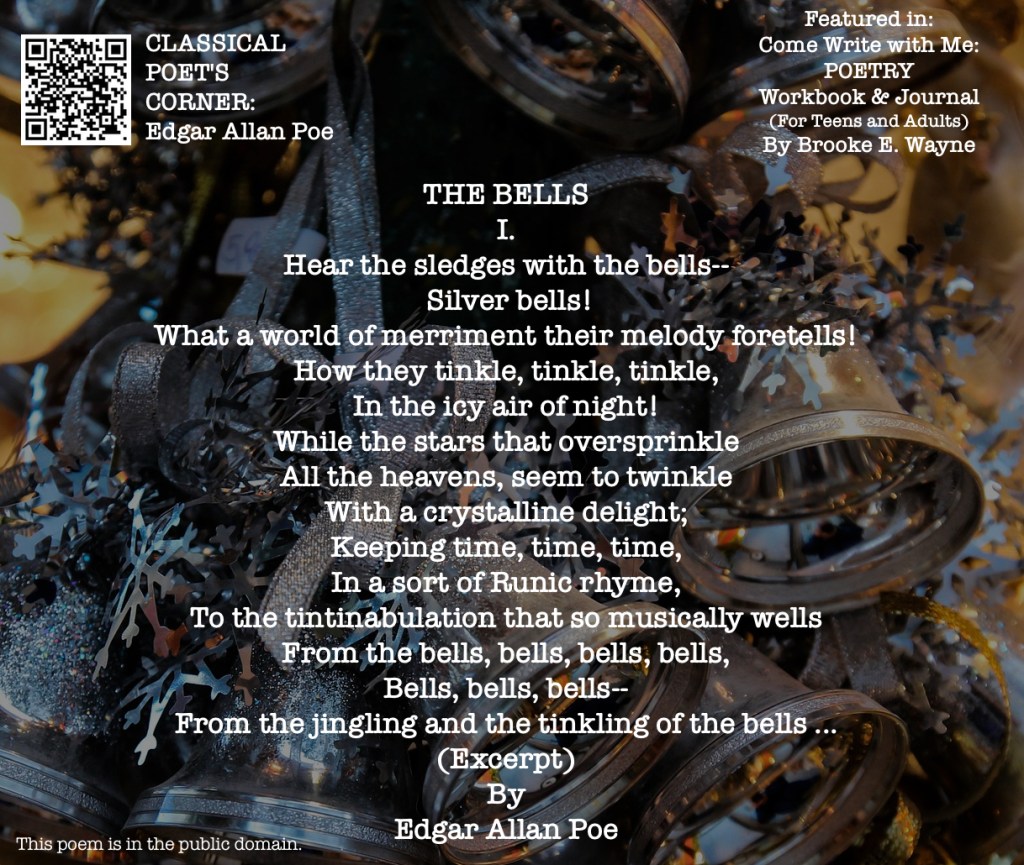
CLASSIC POET'S CORNER: Edgar Allan Poe
A Lesson in ONOMATOPOEIA

Onomatopoeias fall under the poetic device of Imagery, which taps into all five senses. The star of the show for this term is sound. This device uses words that actually imitate the sound they’re describing. Using words as sound effects makes for an imaginative playground in your head. Wrap some SLAM poetry around a handful of onomatopoeias, and your competition doesn’t stand a chance the minute you step up to the mic. This poetic device beckons to be spoken aloud. But, if you’re the silent type, that’s okay. You do you. Just feel free to load up your poems with words that trickle off the tongue with every intention of evoking emotion, or at least let others whisper them while they read your work.

Lots of people think of words like, “pow,” “zoom,” “boink,”–or any other 1960s-Batman-television-show variety–when they think of onomatopoeias. Those are fine. Maybe even a little, meh. I challenge you to level up with some better choices that serve a stronger purpose in the poems you write. Choose onomatopoeias that actually have meaning and provoke sound imagery within a setting you’ve created in your poem that includes other senses, too. My workbook and journal has an extensive list of words to use for every sense. You should take a peek, and use as many as you want.

If the example provided by Poe doesn’t do it for you, check out the complete version of his poem, “The Bells.” I wanted to use the full poem, but since it’s super long—I took a pass worried that my readers would lose interest and want to get right down to writing instead of reading the whole thing. “The Bells,” though, is the quintessential example of all things onomatopoeia, so when you have the time of day (or night—this is Poe we’re talking about, night is a good time to set the mood), then do an Internet search for it and enjoy hearing all the different sounds of the types of bells he celebrates in his poem.

For this exercise, here’s a list of onomatopoeias that would love to hang out in a verse that comes to life with other sensory details:

Trickle          Sputter         Squeak         Crackle            Clap             Squeal

Hush             Howl               Sizzle              Rev                  Woof             Mumble

Gurgle          Warble            Smash             Ring                Splash           Click

Stutter         Whisper          Whine             Fizz                Tick-Tock       Thud

Gulp             Chug              Slurp               Rattle              Slosh               Clip

Here are some scenarios to bring to life with a few sound descriptors:

A lifeboat with two survivors drifting on the turbulent sea, pitch black, nothing but stars …

A hungry wolf stalking its prey, ribbons of neon green flowing above them, the full moon dances with the Northern Lights …

A field of tulips in every color imaginable, a swarm of bees feast on all the nectar …

A man stands in the rain outside her window, drench, shaking, wondering if she knows …

A shark cruises the shoreline, his fin slicing the undulating waves, a surfer mounts his board …

Now, go forth, my word-whisperer, and make some noise all up in those sweeeet poems of yours. I can’t wait for you to share your work with me!

~Brooke E. Wayne

AVAILABLE ON AMAZON
BUY ON AMAZON

CLASSIC POET’S CORNER: Robert Burns

A Lesson in SIMILE

Whether you’ve stumbled upon this section of my website by accident, or if you zapped one of the QR codes in my latest publication, WELCOME!

O, this poem is like so, so overdone

That it’s forever lodged in my head;

Oh, this poem’s so perfect for teaching similes

That it’s what’s proceeding ahead …

Similes have a unique way of wiggling themselves into our everyday language and thoughts. We’re always making comparisons between things. We just do. Robert Burn’s poem capitalizes on comparing red roses among other things to love or as the poets in the 1700s would say, “luve,”  (go ahead and let it roll off your tongue with a purr in that swagger-inducing accent you hear in your head. You know you want to. Do it. Duuuu it.)

The cool thing about similes is they bring anything to life including that first line of your writing called a hook that you’ve been banging your head against your keyboard over trying to come up with for hours. Be it a novel, short story, or even an expository term paper, it’s a guarantee you’ll reel your reader in with a simile because it forces one’s imagination to action.

Slip this poetic device into your stanzas and build a thought-bank of comparisons for your reader to mull over. People will nom those similes up like a never-ending bucket of popcorn. Striking on imagery and complementing other devices such as hyperboles and personification, similes beguile because they require tangible items to get their creativity on.

Here are some emotions, objects (concrete nouns), and personality attributes that pair well in comparison with concrete images.

Mix and match or chose a word and create your own personalized list:

Affectionate   Angry     Brave     Clever    Extravagant

Happiness   Helpless  Joyful  Love    Lonely

Neurotic    Outgoing   Patriotic    Pleasant   Reserved

Sad   Shy   Sophisticated   Tender Troubled

Uplifting   Visionary     Venturesome   Wise   Young

Apple Orchard   Atomic Bomb   Butterfly   Bull   Campfire

Candlelight   Castle   City Lights   Dungeon     Earth

Fireplace   Home   Horseback    Jungle   Laboratory

Meteor Shower   Mountains   Rainbow   Seaside   Sky Scrapers

Space   Street Lamps   Trees   Urban Streets   Wild West

STORM: abandoned, beach house, bitter cold, blanketed, blizzard, cabin, chilling, cottage, crackling, darkness, droplets, electric, flashes, frost, hail, hurricane, ice, lightning, pelting, pressure, rain, rattling, sleet, snow, snowflakes, stillness, thunder, tornado, winter, wind

EXAMPLE: The troubled pain in her eyes gripped me like a lightning storm, as she flashed bitter cold resentment in a single glare before walking away–my words of ending ‘us’ abandoned in the stillness she left behind without a word.

SUNSHINE: apples, berries, boats, breeze, bright, cabin, clouds, coconut, cotton, fruit, grass, hammock, heat, iced tea, jam, lemonade, mountains, pineapples, sailing, sand, strawberries, summer, sun rays, sweet, warm, white picket fence, whispering, wild flowers, windy

EXAMPLE: Happiness broke loose in her heart like sun (rays bursting free from behind a solitary cloud, scattering her mournful thoughts as memories of making homemade jam with wild strawberries gathered on her grandparents’ summer property invaded her mind when she stepped into the aging cabin in the mountains.

Yes, I have been known to write the world’s longest sentences. Please, forgive me.)

Here’s another exercise for you to play around with. Try to incorporate these sensuous elements into a verse that includes a comparison of something totally unrelated. I bet you’ll be a pro at it in no time!

Looks like a pile of cogs and gears

Tastes like a bag of stale bagels

Smells like a bouquet of wild flowers

Feels like a crisp stack of a million dollars

Sounds like a heart beating in love

Sweet like a little kid’s lollipop

Putrid like a drain

Fragrant like a bottle of the sweetest French perfume

Painful like a knife to the heart

Cleansing like a deluge of fragrant, summer rain

Healing like the veins of gold holding broken china together (kintsugi)

Now, go forth, you cultivator of cool beans, and find that perfect pairing to match up and stuff in a poem like a __________. I can’t wait for you to share your poetry with me!

~Brooke E. Wayne

AVAILABLE ON AMAZON
BUY ON AMAZON

CLASSIC POET’S CORNER: William Wordsworth

A Lesson in Personification

Whether you’ve stumbled upon this section of my website by accident, through the WP Newsfeed, or if you zapped one of the QR codes in my latest publication, WELCOME!

Personification is the party animal of the poetic devices. It takes a boring, stationary object that lacks personality and charisma and breathes life into it. Suddenly that ‘thing’ becomes a ‘her’ and she’s all kinds of sexy with a little smidgen of swagger and a whole lotta charm. What if she was a brick red tube of lipstick? See what I mean? Alive. Telling a story. Living the dream.

William Wordsworth had it all going on when kicking back on his couch, daydreaming of the good stuff. You can almost hear all those daffodils in harmony singing their little hearts out about all that sunshine and happiness. Loaded with similes, too, let this jovial poem inspire you. Search through your existing poems, and find objects you could set in motion, then edit your work to include phrases with humanlike actions, or at least switch up the pronouns, and set the objects free from their inanimate dungeon.

You can also make a list of objects and actions or feeling for these new items to experience then throw them into a circumstance. Now, write some phrases and toss them into a new poem, like the rockstar poet you know you are.

Here, I’ve started a list for you:

OBJECTS and ACTIONS:

Rain—–Caress, Tickle, Pinch                                                                 

Rainbow—–Sing, Whisper, Rejoice                                                        

Ocean—–Cradle, Rage, Call                                                                    

Ferrari —–Purr, Calculate, She                                                                   

Bed—–Beckon, Moan, Embrace                                                                                

Wedding ring—– Speak, Secure, Promise

Garden—– Celebrate, Mentor, Please

Finally, you can bring living-like action to objects and emotions, too. But, just so you know, this technique straddles the poetic device of implied metaphor depending on what it’s being compared to. Think, “Does it have a heartbeat?” then, we’ll let it slide and call it personification for this exercise. If it’s alive but doesn’t have a heartbeat, then it’s probably safer to stick it in the metaphor bubble. You can even hit up my Categories list on my home page for more of these Classic Poet’s Corner blogs to find the one on Metaphors and go from there if you don’t have Come Write with Me: POETRY Workbook & Journal (For Teens & Adults). If you have the book—cool—you can flip ahead and check out the Metaphor page then come back here later.

Comparative Examples:

The torrid lava clawed its way to the edge of the city, obliterating all things in its vengeful path. (Personification—The action and emotion embodied in the lava could be construed as animalistic or human (a super scary human!)

Love wound its tentacles around my heart and dragged it into the depths of all things hearts and flowers. (Implied Metaphor—Love is an octopus.)

Bitterness pricked my heart, leaving it wounded and oozing with pain. (Implied Metaphor—Bitterness is a thorn.)

And, hear me out, you can even bend the rules a bit and put living characteristics to an inanimate object or emotion that aren’t necessarily human.

Now, go forth, you crafter of creativity, and let out all that eager poetry knocking on your heart’s door. I can’t wait for you to share your poetry with me!

~Brooke E. Wayne

BUY ON AMAZON
AVAILABLE ON AMAZON